Hey👋,
I'm Giacomo

Thanks for reading my daily curation of AI and marketing ideas

Portrait of Giacomo Iotti with short dark hair and brown eyes, wearing a dark turtleneck and a dark checkered blazer against a dark background.

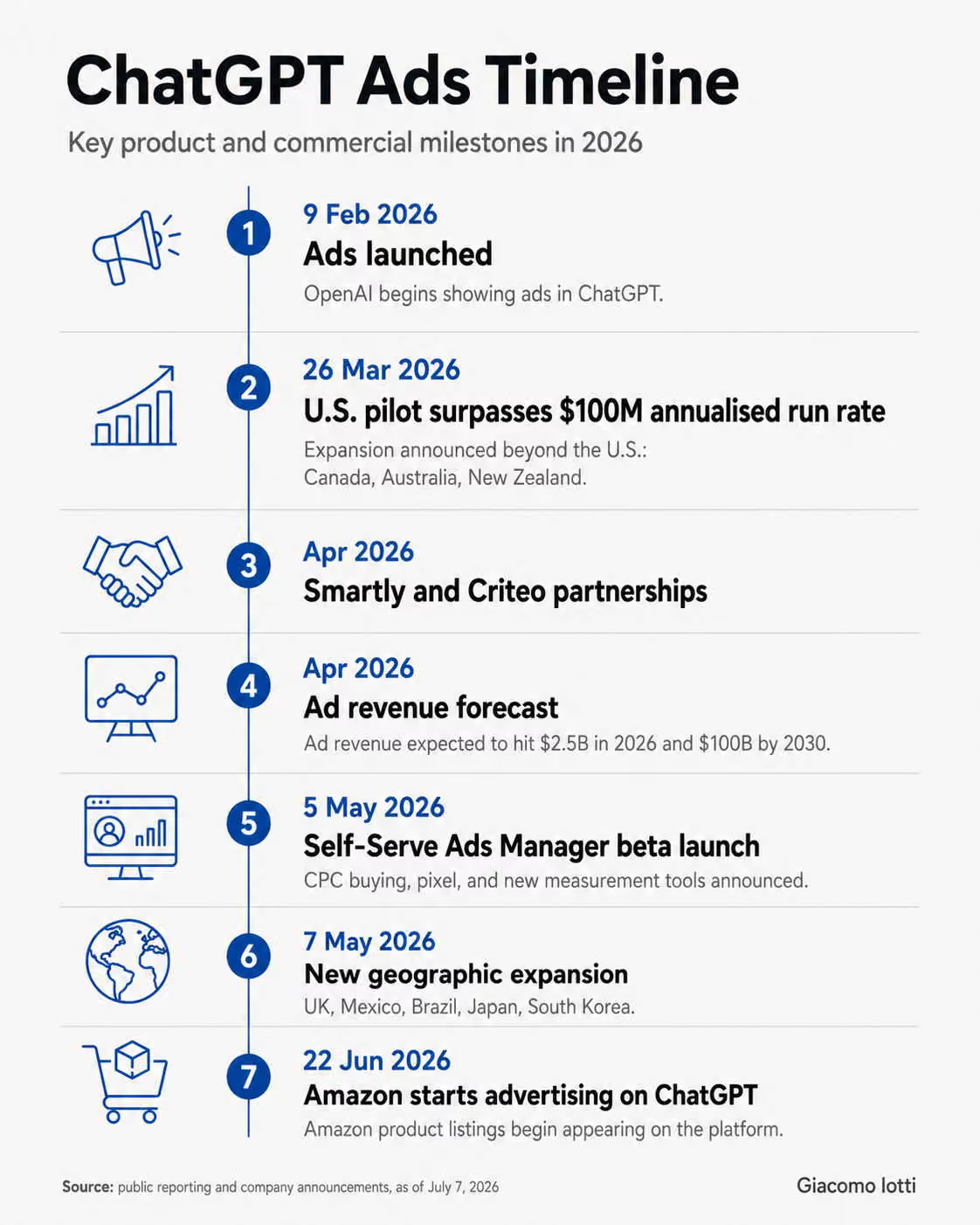
Imagine managing every ad campaign directly through ChatGPT.


From Google Ads to TikTok and Programmatic. All by just asking “target sport enthusiasts with a 10k budget”.


That’s what the folks at AdCP are building.


An MCP connector designed to unify all ad platforms in one place.
From audience targeting and campaign activations, to reporting.


Not sure it will ever take off.
It seems the big players aren’t on board yet.


Still, the idea is intriguing.
One way or another, we’re heading there.


Since even AI chatbots will soon sell ads themselves, AI-driven buying will become the natural default.


Even now, tools like Google Search Ads 360 are bringing more platforms under one roof, soon including Meta and Criteo as well.


I gave a webinar about this last week.


Because despite few giants and budget concentration, the ad industry is still very fragmented and overly complex.


Maybe this is how we finally start to simplify it.


...more
Open on LinkedIn
Expand on page
Portrait of Giacomo Iotti with short dark hair and brown eyes, wearing a dark turtleneck and a dark checkered blazer against a dark background.

Taylor Swift built the biggest “niche” fan base in history.


There are two schools of thought in modern marketing:


1️⃣ Win your niche and build customer loyalty.
2️⃣ Go broad, chase reach and new customers over loyalty.


Normally, these two strategies are mutually exclusive.


Sure, a new brand can start with the first and then scale into the second.


💡 But Taylor Swift somehow does both at the same time!


She created a “niche” superfan base made of millions.


Swifties are in the millions but aren’t casual listeners.
They’re emotionally invested, fiercely loyal, and they buy repeatedly.


Take her latest album.
The same record was released in ~40 variations.


So her loyal fans could buy the exact same product up to 40 times!


And yet, her loyal “niche” fills stadiums worldwide.


This breaks every marketing textbook rule.


How does she pulls this off?
Nothing less than strategic evil genius. 😈


She positioned herself as a close and relatable female friend…


…while becoming the first billionaire musician in history.
(and being the blonde cheerleader who married the football team captain LOL)


The least relatable person imaginable 😂


The key is that she makes every fan feel seen, special, and unique;
even when there are 100 million other “unique” fans. 😅


Like I said last Sunday:
👉 Marketing is all about feelings.


Make people feel something they want to feel again.


Everything else doesn't matter as much.


...more
Open on LinkedIn
Expand on page
Portrait of Giacomo Iotti with short dark hair and brown eyes, wearing a dark turtleneck and a dark checkered blazer against a dark background.

OpenAI’s deal-making is out of this world.


Big Tech is all in.
Capital, credit, strategic partnerships, everyone wants a piece.


And yet…
OpenAI keeps losing money.


💸 For every $1 it earns, it spends about $2.20 (Financial Times).
🔥 It's burning cash like crazy -> $8 billion loss in H1 2025.


Still, Big Tech and Wall Street keep pouring in cash.


Bubble, or the biggest leveraged play in tech history?


I’d argue for the latter.


Because OpenAI is only getting started!


Right now:
→ Only 5% of its 800M+ users are monetised.
→ 70% of its $13B ARR still comes from ChatGPT subscriptions.


What’s next is ten times bigger:


→ More focus on enterprise + API sales (massive B2B upside).
→ Renting infrastructure, AWS-style.
→ Ads (nobody has better users data than GPT).
→ Shopping commissions (already in motion).
→ Sora social network and monetisation.
→ A hardware device designed by star Jony Ive (might launch next year).


The loans and large losses scream "bubble" left and right.


Except, it's not.


...more
OpenAI logo and partnerships with companies like Oracle, Google, Amazon.
Open on LinkedIn
Expand on page
Portrait of Giacomo Iotti with short dark hair and brown eyes, wearing a dark turtleneck and a dark checkered blazer against a dark background.

🚨 Just spotted on Google,


it seems you can hide ads now!


I'm sure many will overlook the button and struggle even more to tell ads from organic results.


But what if people do notice and keep hiding ads?


What's the point of selling ads if users can simply hide them?


I'm sure Google is just experimenting with it, probably trying to find a new compromise between organic results, ads and AI overviews.


But if now, this is huge!


...more
Google search result page with an option to hide sponsored results.
Open on LinkedIn
Expand on page
Portrait of Giacomo Iotti with short dark hair and brown eyes, wearing a dark turtleneck and a dark checkered blazer against a dark background.

Sunday thoughts:


What is marketing?


After 10 years in the industry, I still struggle to give a single, convincing answer.


But something dawned on me lately.


I might not know what marketing is,
but I know what marketing should do.


💡Marketing should make your prospective customers “feel” something.


Because great marketing is all about feelings.


It isn’t about what it communicates.
It’s about how it makes you feel when it does.


When I see an ad by Audemars Piguet, I feel wealthy.


Even though I’m not.
Even though I’ll never afford one.
Even though I’m not even into watches.
Even though my $80 Swatch makes me perfectly happy.


But feeling wealthy is a good feeling.
And I’ll always associate this brand with a good feeling.


That’s all that matters.


And If I ever become wealthy, indeed Audemars Piguet will be the first brand that comes to mind.


When I see marketing from The Economist, I feel smart.


That’s why I’m a customer.


Not because I am objectively smart, but because I like to “feel” smart.


Even better, I like to feel smarter than others.


The simple fact that the ad was served to me (and possibly not to someone else) already reinforces my feeling.


And again, that’s all that matters.


Some marketing makes you feel like sh*t.
On purpose.


The promise?
Buy, and you’ll stop feeling like sh*t.
Buy, and you’ll be happy again.


The classic “Buy now! tomorrow the price will double” just makes you feel FOMO, stress, and discomfort.


And that’s why you buy: to stop feeling like that.


It’s now proven that ChatGPT is increasingly used as a personal assistant, as a life coach or even as a friend.


Our interactions with consumer AI are highly emotional. Who hasn’t argued with their chatbot?


As marketing increasingly flows through AI conversations, its emotional side, not the technical one, will only grow in importance.


...more
Open on LinkedIn
Expand on page
Portrait of Giacomo Iotti with short dark hair and brown eyes, wearing a dark turtleneck and a dark checkered blazer against a dark background.

Want more money?


Switch job.


Old story. Everybody knows it.


But it’s not just about higher wages.


👉 It’s about pace of innovation.


New hires bring new ideas.
Sometimes they disrupt decade-old processes.


Frequent reshuffle forces innovation.


The US is leading this trend, while Italy is a negative outlier.


Many elements explain this gap.


But the best companies even in the US retain people for the long run.


Think of Doug McMillon, who went from summer intern to Walmart CEO in over 30 years at the company!


As always, the best soup is the one with just the right temperature.


Between hopping jobs every year and staying 20+ years, there’s a massive in-between that companies should encourage.


Especially now. In the age of AI.


Companies must accept to be disrupted from the inside, by their own people, rather than waiting for outsiders.


Great companies attract talents who bring great ideas. Day one. Year five. Year ten.


But they must listen. And trust.


If not, those ideas will go elsewhere.
And so will the money.


Big Tech nailed this.
It’s not unusual to see employees staying 10+ years while still driving crazy innovation.


Something Italian, and more broadly, European, companies should definitely learn from.


...more
Open on LinkedIn
Expand on page
Portrait of Giacomo Iotti with short dark hair and brown eyes, wearing a dark turtleneck and a dark checkered blazer against a dark background.

Sunday reminder:


The fertility crisis is not a global problem.
It’s a rich-world problem.


Yes, fertility rates are declining more or less everywhere.
But how much “more” or “less” makes all the difference.
And so does the starting point.


Most developed countries now sit below the 2.1 replacement rate.


Meanwhile, many other countries, especially in Africa, still have fertility rates above 5 or even 6.


This matters.
Because while Italy or Japan shrink, Nigeria already counts 100M+ people and has already surpassed many Western nations.


No serious immigration discussion can ignore this.


Declining population is not a problem in itself.


Governments and economies have many tools to adapt. Even several opportunities exist.


But world population is NOT declining.
Only the West’s is.


Global population is projected to peak in no less than 50 years.


Plenty of time for more drama around immigration debates.


AI is meant to replace retiring workers, boost productivity, and solve demographic challenges in Western countries.


But will it?


Or will history repeat itself with another great reshuffle of who lives where, just like it has for thousands of years?


...more
Open on LinkedIn
Expand on page
Portrait of Giacomo Iotti with short dark hair and brown eyes, wearing a dark turtleneck and a dark checkered blazer against a dark background.

Switzerland is consistently at the top of the world’s most innovative countries.


Essentially, it’s the place to be!


US only third place despite AI breakthrough, crazy!


Oh, and among the top 15 countries, 8 are in Europe. More than half 😏.


Just to add some data to the never-ending Europe vs US discussion.


...more
Open on LinkedIn
Expand on page
Portrait of Giacomo Iotti with short dark hair and brown eyes, wearing a dark turtleneck and a dark checkered blazer against a dark background.

Over half (57%) of Google clicks never leave Google!


Let that sink in.


That means less than half of all clicks actually land on other websites.


Websites run by businesses like mine and yours.


What’s interesting is that this hasn’t shifted much with the launch of AI Overviews at the end of 2024.


External clicks are down slightly year-over-year, but nothing dramatic.


This is because the “death of clicks” started long before AI:


-> Knowledge boxes
-> Featured snippets
-> Social platforms punishing external links


AI isn’t the beginning.
It’s just the continuation.


The trend is clear and marketers need to adapt.


Whether it fits their legacy beliefs or not.


...more
Distribution of Google US desktop search clicks over time, April 2024 to May 2025.
Open on LinkedIn
Expand on page
Portrait of Giacomo Iotti with short dark hair and brown eyes, wearing a dark turtleneck and a dark checkered blazer against a dark background.

Couldn't agree more with this post.


A new era of marketing is here,
whether we like it or not.


Yet, many technical marketers are still in denial.


Their "hacks" just don't work anymore.


👉 Channel attribution?
Dead ⚰️
Killed by privacy regulations, death of cookies and death of clicks.


👉 Granular targeting?
Dead ⚰️
Killed by AI media buying and privacy regulations.


👉 SEO hacks?
Dead ⚰️
Killed by AI search.


👉 Funnel?
Dead ⚰️
Killed by the Messy Middle and the new AI-mediated consumer journey.


So what's left?


The FUNDAMENTALS of brand building.
Just like in the pre-internet era.


Bold ideas.
Creativity.
Strong PR.
Quality Content.
Broad reach.


These are the marketing elements that will define successful brands going forward.


...more
Open on LinkedIn
Expand on page