AI-era leaders cannot afford to leave the real work
Everyone wants to become “strategic”.
They want to leave execution to others.
That is what promotions are for, they think.
But when they do get promoted and become “strategic”, they often lose touch with reality.
They stop understanding how the actual work is done.
They stop noticing quality problems early.
They stop learning.
I was reading Ron Friedman, Ph.D. HBR article on "superteams", and one finding stood out.
After surveying more than 6,000 knowledge workers, Friedman found what superteams do differently:
Superteam leaders stay close to the work.
They roll up their sleeves and contribute alongside their team.
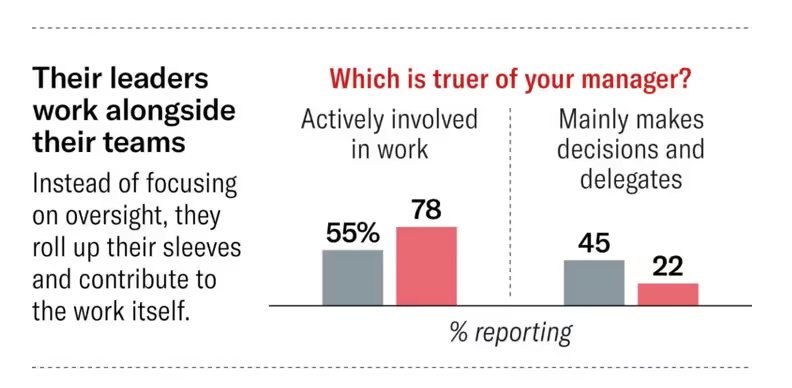
The chart below speaks for itself.
78% of superteam employees said their managers were actively involved in the work, vs. 55% for average teams.
They don't stay close to the work to micromanage or to control every detail, but to understand what is really happening. And most importantly, to keep learning and improving.
It might sound obvious.
But in many corporate cultures, seniority equals distance from execution.
The leader "made it".
Now others do the work.
This culture may have been dangerous before.
In the age of AI, it is disastrous.
Technology is moving so fast that no leader can afford to stay hands-off.
AI makes hands-on understanding more important than ever, because the baseline keeps rising. What used to be complex is becoming easier. So to compete, teams need to keep raising the bar.
Superteams experiment, make mistakes, stay curious, learn from one another and practice continuous improvement. This is mandatory in the age of AI.
But that culture cannot exist if leaders talk about continuous improvement from a distance without practicing it themselves.
HBR article: https://lnkd.in/eKyf8K9U