I help brands grow in the age of AI
September 21, 2026
Last week I started a new job at comparis.ch AG
AI knows it already!
...more
Last week I started a new job at comparis.ch AG
AI knows it already!

Marketing has tolerated bluffing for too long.
Now even excellent marketers are paying the price.
I don't have first-hand experience (yet) of what Mark Ritson describes, but I believe it.
In another study, Ritson found that 65% of marketers lack even the most basic marketing knowledge.
Would we accept the same elsewhere?
A software engineer who doesn't understand software fundamentals.
A finance professional who doesn't understand basic finance.
A product manager who doesn't understand UX.
Probably not.
Of course, every profession has weak practitioners.
But marketing has been unusually tolerant of fluffy language and sloppy or outsourced execution.
That was always a weakness.
And now the chickens are coming home to roost.
Marketing is becoming far more complex, technical and competitive.
Consider digital marketing.
Traditional marketers may still know little about it, yet digital now occupies perhaps 90% of CEOs' agendas.
Meanwhile, marketing is climbing the executive agenda.
"marketing is too important to be left to the marketing department", the quote goes.
So CEOs have less patience for impressive vocabulary without real expertise, especially in digital.
A study by Boathouse found that only 32% of CEOs trust their CMOs.
No wonder. And it is highly problematic.
Marketers who have never got their hands dirty or understood digital, let alone AI, certainly won't improve that trust.
No surprise some are struggling to find work.
But others already occupy senior seats and, aware of the changing market, are unlikely to leave.
That reduces turnover and senior openings, blocking even excellent marketers caught in broad layoffs, restructuring or similar circumstances.
Marketing is not changing.
Quite the opposite: its fundamentals couldn't be more relevant today.
It's the skills of the people doing marketing that are, or should be, changing.

Is your organic traffic dropping?
You're not alone!
It's no secret,
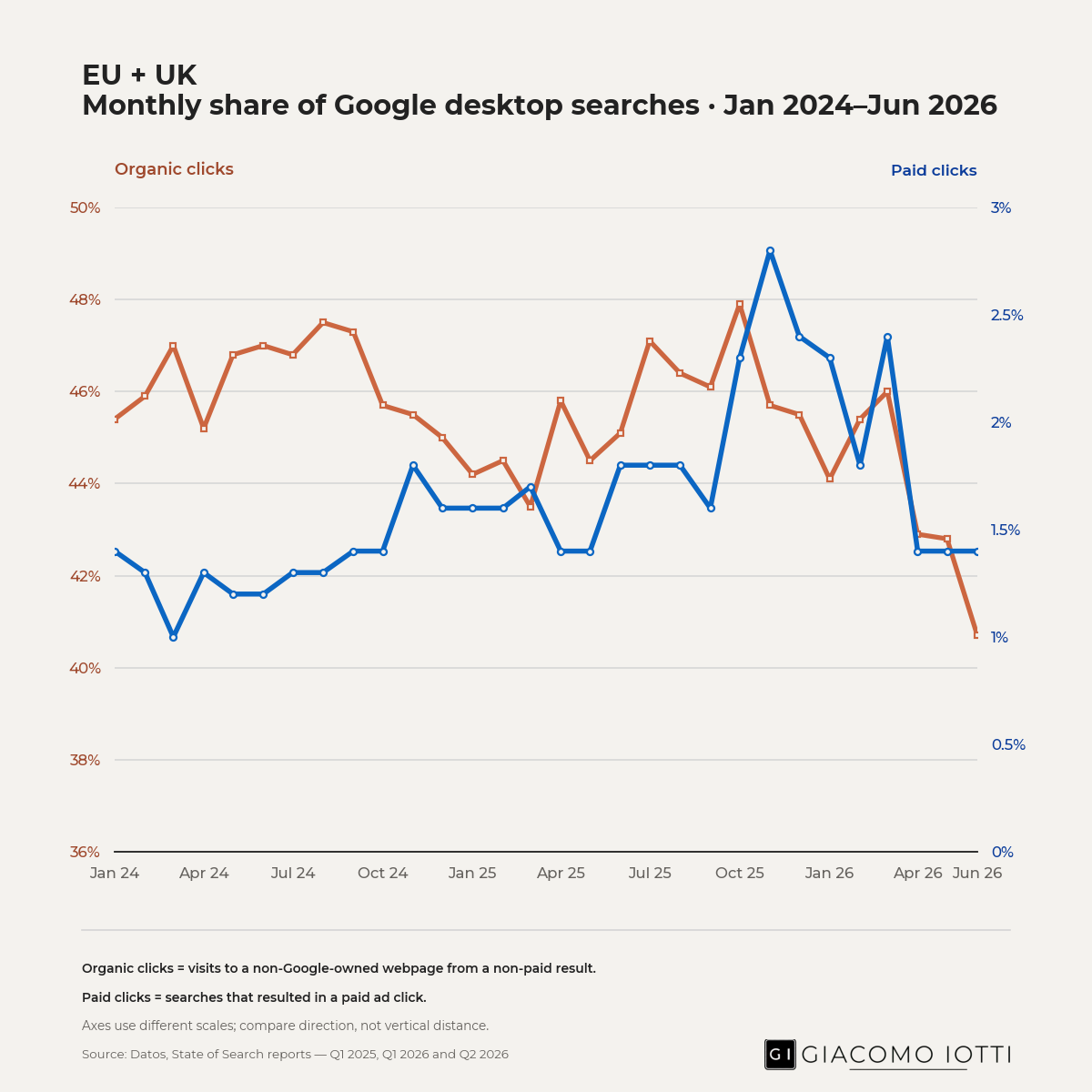
since AI Overviews were introduced, organic traffic has started to decline.
At first, the impact was felt mainly by informational blogs.
Now, it is increasingly affecting all types of businesses as the share of queries triggering AI Overviews continues to grow.
But Google cannot simply stop sending traffic altogether.
It needs to make money and monetise those searches somehow.
And that may explain why the share of paid clicks has increased over the past couple of years. Yes, it dropped again after a sharp peak in recent months. But the broader two-year trend is hard to ignore.
And it makes perfect sense.
Ads can appear above, below and within AI Overviews.
When they appear within AI Overviews, they are often displayed more prominently than organic citations.
Because remember:
AI Overviews provide answers, not search results.
External links are merely optional citations, not the core product as traditional organic results used to be.
But ads are different.
They need to be visible.
And they need to be clicked.
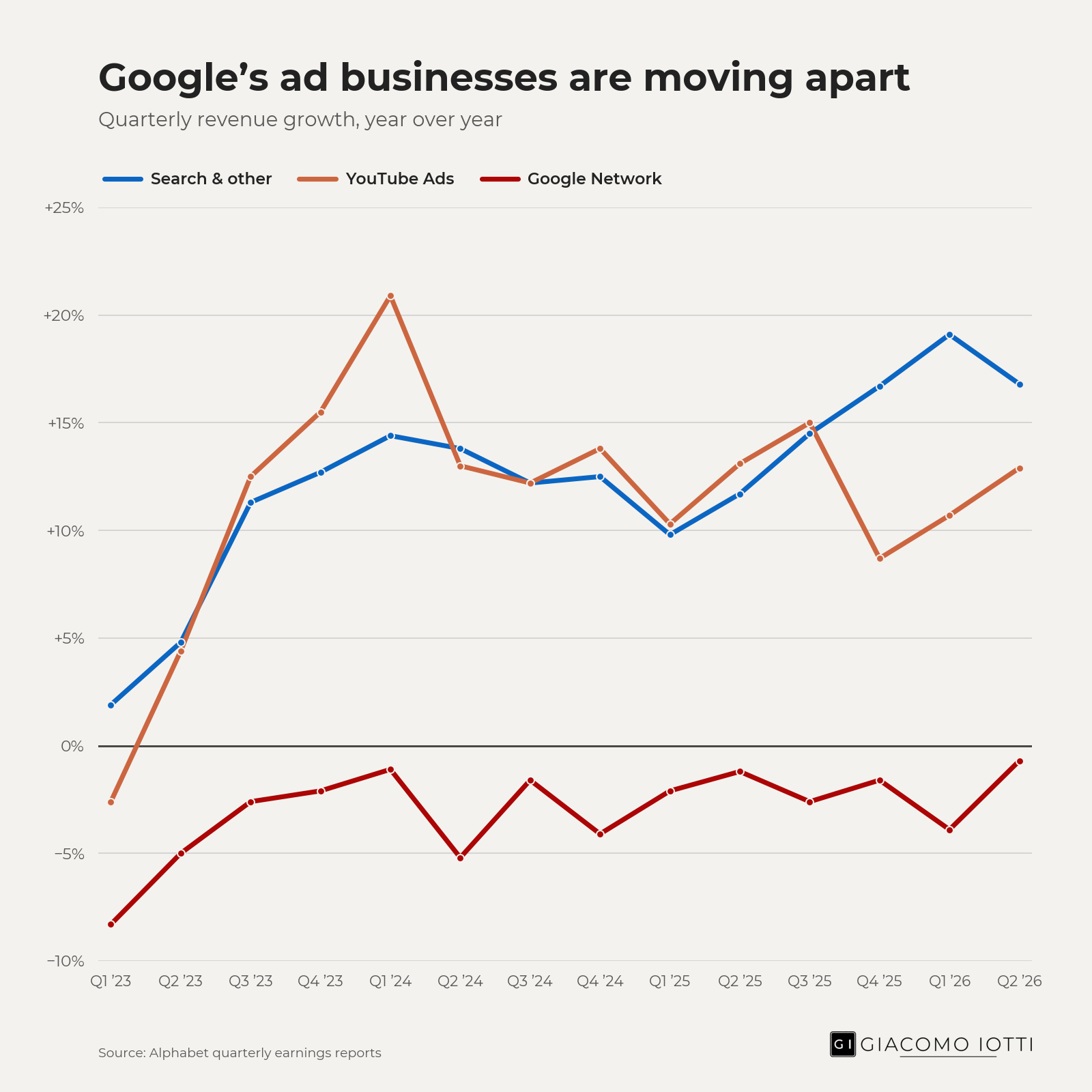
Google Search revenue reached an all-time high last quarter. Its growth even surpassed YouTube’s.
The direction Google is moving in couldn't be clearer.
Have you noticed the same trend in your business?
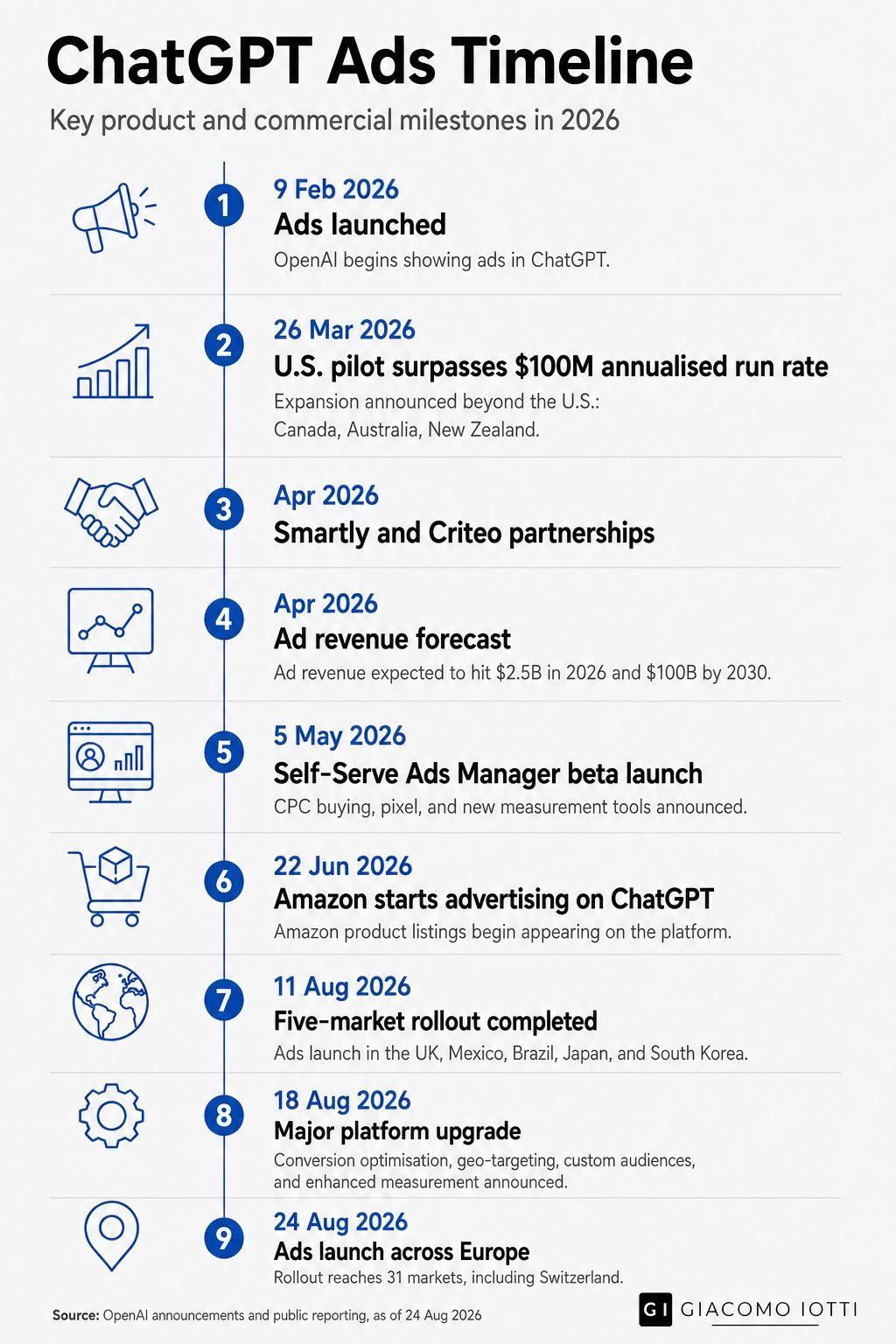
Yesterday, ChatGPT Ads launched in Europe.
In less than eight months, they went from being little more than a rumour to becoming a serious challenger to the Google-Meta duopoly.
Sure, it’s still very early.
Most advertiser spend will probably come from experimental or “bets” budgets, rather than being reallocated from Google or Meta. The duopoly is not at risk, yet!
But what OpenAI has achieved in such a short time is extraordinary, with almost no precedent in advertising history.
Google and Meta both took years (decades?) to develop the ad products they’re known for.
TikTok did too.
As I’ve mentioned in previous posts, ChatGPT Ads are a different beast.
They’re not purely performance advertising.
They’re not branding.
They’re something new in between.
Then there are conversational ads, arguably the most innovative and interesting format.
Users don’t just see an ad and click on it.
They can chat with it.
That is genuinely innovative and will introduce a whole new set of KPIs:
• Chat-through rate
• Three-question chat rate
And who knows what else.
But don’t expect ChatGPT Ads to generate huge volumes of traffic.
We’ve all seen the numbers:
• Expensive average CPC: $12
• Low average CTR: 0.68%
Plus,
73% of conversations don’t end when the ad appears.
Users keep chatting with ChatGPT even after seeing an ad. For another four turns on average.
This means they will likely reach your website only after leaving ChatGPT, rather than directly through the ad.
They could arrive through direct traffic, organic or paid search, social media…
Who knows!
Accurate attribution will become extremely complex, if not almost impossible.
Welcome to a new era of online advertising!
Have you tried ChatGPT Ads yet?
What’s your experience?
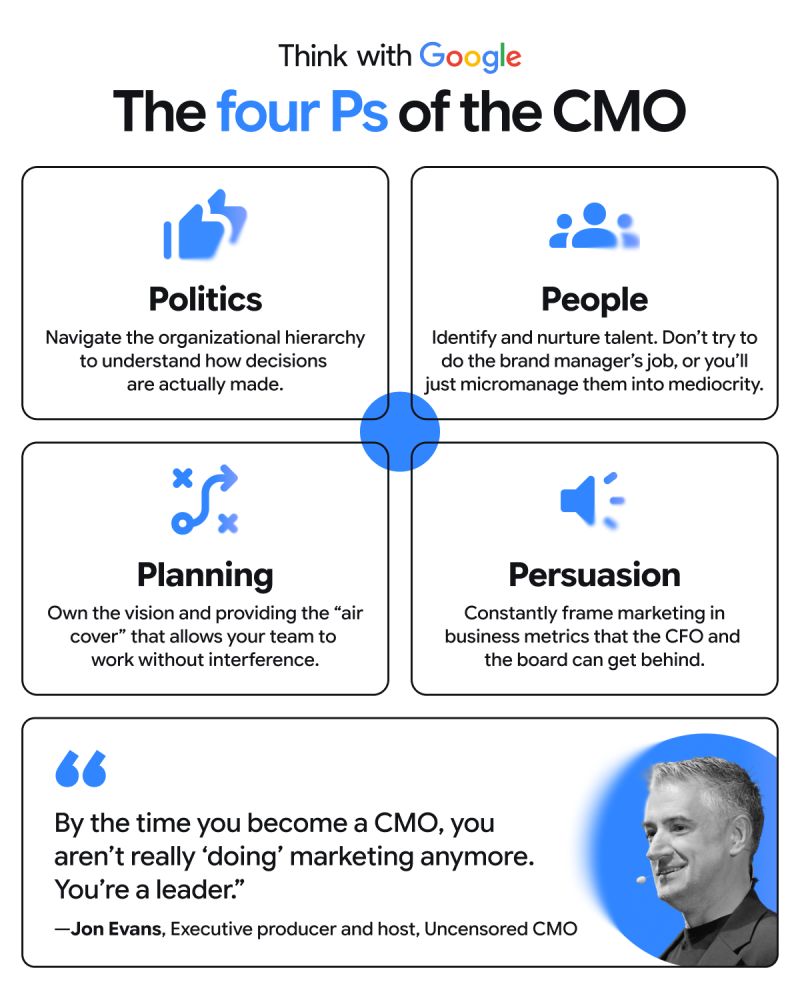
I strongly disagree with this.
I even had a “heated” comment exchange with Jon Evans about it.
A CMO is not just another leader.
If CMOs, who literally have “marketing” in their title, stop doing marketing and become “just” leaders, what distinguishes them from any other executive?
How are politics, people, planning and persuasion unique to a CMO?
Aren’t these skills expected from a CFO, CTO, COO, or any leader in general?
Maybe, and I say maybe, only the CEO can afford to be “just” a leader.
Every other C-level executive has a functional responsibility first.
Leadership comes on top.
Leadership is the multiplier.
Functional expertise is the non-negotiable base.
HBR has a piece right on this concept.
Of course, C-level executives don’t do the hands-on work themselves.
But that doesn’t mean they stop doing their function.
A CFO remains an expert in finance.
They still manage the company’s financials and discuss them in depth during investor calls.
The same applies to a CTO.
Nobody has ever argued:
“By the time you become a CFO, you aren’t really doing finance anymore.”
So why should that be true for a CMO?
At the very least, a CMO should define the marketing vision and strategy in detail.
Then delegate implementation to their teams.
A CMO is also the ultimate owner of the brand.
That doesn’t mean micromanaging the brand manager.
It means taking ultimate responsibility, and therefore ownership, of the brand.
If you’re a CEO and apply only these four Ps when hiring your next CMO, you’ll hire a polished corporate politician rather than a marketer.
That is the exact opposite of what marketing needs.
Especially in the Age of AI when change happens at light speed.
I believe this mindset helps explain a brutal gap:
• 43% of CEOs grade their CMOs a “C” or “D” on their ability to drive company growth.
• Only 16% receive an “A”.
• Just 32% of CEOs trust their CMOs, compared with 90% who trust their CFOs.
According to the Journal of the Academy of Marketing Science study, 54% of CMO roles are misaligned.
Meaning, occupied by the wrong people.
That creates a vicious circle.
Almost any corporate worker can learn to become a good corporate politician.
But that doesn’t mean they can drive growth through marketing.
So they don’t make much impact.
But the less impact they make, the more politics they need to justify their position.
The less impact and the more politics they do, the less their CEOs trust them.
A CMO must be a marketer first, and then become more than that.
But they cannot stop being one.
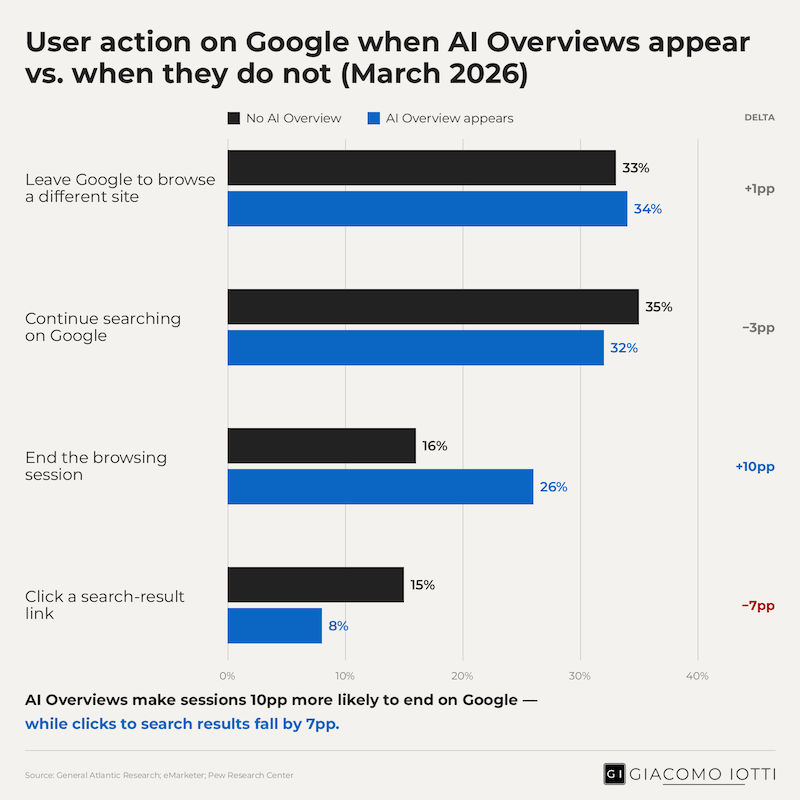
AI Overviews are turning Google into a free AI chatbot.
Look at this 👇
When AI Overviews appear, users are more likely to leave Google without clicking on any result.
But that's not all.
They're also 10 percentage points more likely to end their browsing session entirely!
It makes sense.
Chrome is the world's most popular browser.
For most users, Google is the default search engine.
They have a question.
They open Chrome.
They type it into the address bar.
They get a satisfactory answer.
They close Chrome.
That's it.
We need to come to terms with the fact that people will increasingly use Google as a free AI chatbot, rather than as a gateway to the web.
Google itself is accelerating this shift by pushing AI Mode as a direct follow-up to AI Overview answers.
In that world, the distinction between SEO and GEO becomes non-sense.
Google is turning into an AI chatbot.
AI chatbots are turning into search engines, ads included, as we're already seeing with ChatGPT.
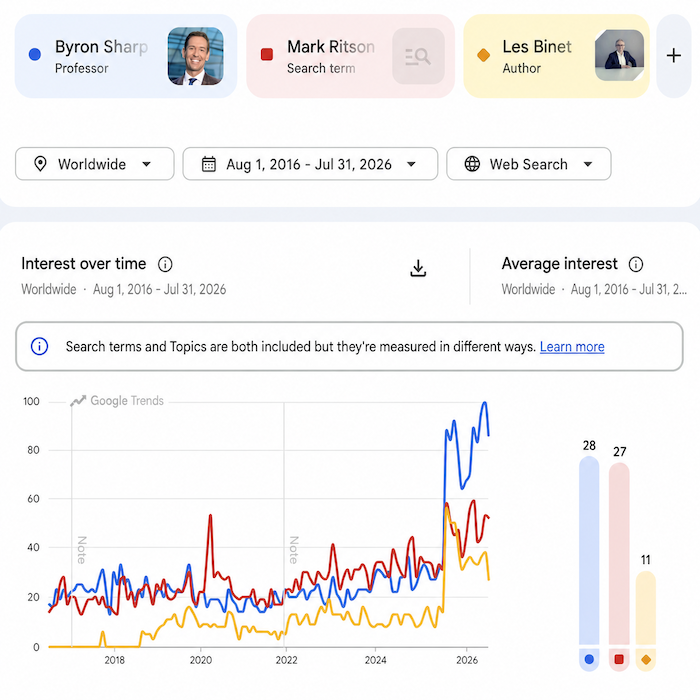
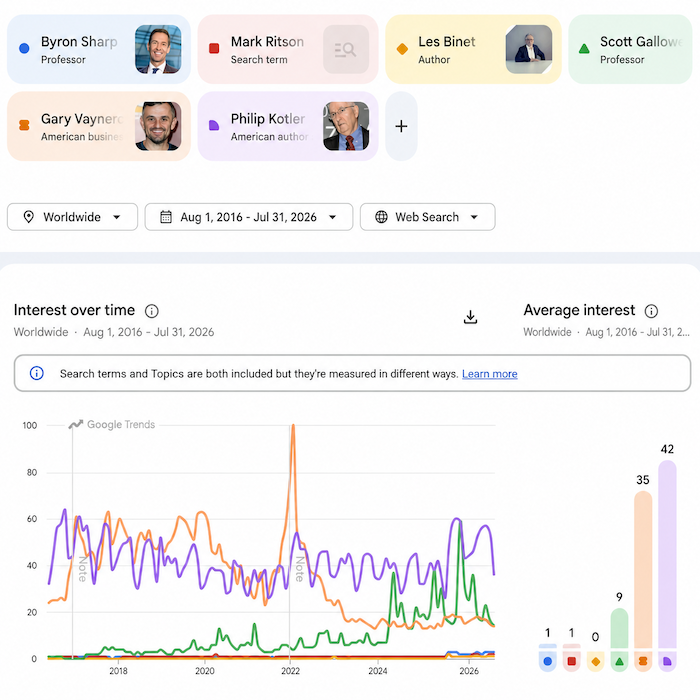
Byron Sharp is everywhere on my LinkedIn feed lately.
So are Mark Ritson and Les Binet.
It feels like they have always been the "gods" of marketing.
But Google Trends tells a different story.
All three built distinguished careers over decades.
Sharp’s bestselling book "How Brands Grow" was published in 2010.
Yet search interest in all three remained mostly flat until mid-2025.
Then it suddenly jumped.
I have to admit, that’s also roughly when I discovered them.
I don’t know exactly what triggered the surge.
I’d genuinely love to hear your theories in the comments!
But the chart reveals something interesting about online bubbles.
If you asked me today, in August 2026, who the most influential marketing thinkers are, I would probably name these three.
Not necessarily because they are objectively the most influential.
But because my LinkedIn feed has made them omnipresent.
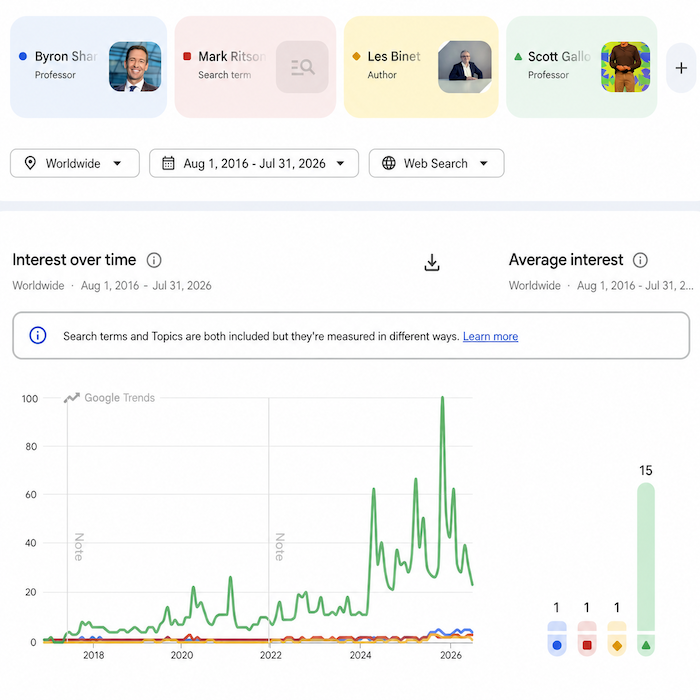
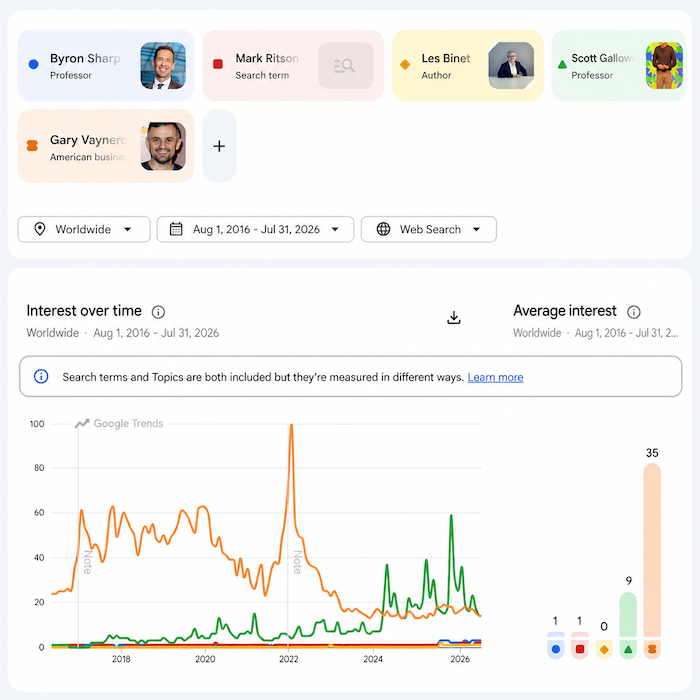
Meanwhile, the likes of Gary Vaynerchuk and Scott Galloway still attract far more search interest. Yes, both have expanded well beyond marketing.
But I still find their views on marketing highly relevant, especially Gary V’s.
And Philip Kotler, the father of modern marketing, remains by far the most searched of them all.
This doesn’t make Sharp, Ritson or Binet any less valuable.
It just shows how quickly a feed can turn experts into "gods".
Your feed is not the world. It’s a bubble.
And sometimes, a very recent one.
Who knows more of what happened in mid-2025?
As someone with both a bachelor’s and a master’s degree in marketing, I can only confirm.
Way too many people in corporate have an opinion on marketing.
Let the marketing professionals do their jobs, just as you let your lawyer do theirs.

Would you connect your bank account with ChatGPT?
Analysing my finances is one of my most common tasks on ChatGPT.
Now, OpenAI is launching direct connections with major financial institutions.
No more uploading spreadsheets, copying and pasting numbers.
It’s a great feature that millions of users will love.
But I’m not going to use it.
At least not yet.
Because connecting ChatGPT directly to my bank accounts crosses a line I’m not comfortable crossing, yet.
And I’d argue many people feel the same.
This information could (and most probably will) be used for advertising.
Or worse, for profiling and intelligence purposes.
I’m (kind of) okay with Big Tech inferring my income and wealth from my online behaviour and chats.
But handing over the raw numbers directly, no thanks.
Let’s see how the product develops.
There may come a time when opting out no longer feels like a realistic choice.
Just as it happened with Google and social media.
Google Search is growing faster than YouTube.
For three consecutive quarters, Search & other ad revenue has outgrown YouTube Ads.
YouTube has long been Alphabet’s growth darling, often outgrowing Search.
It made sense: a newer product, huge ad inventory, lower monetisation.
Not anymore.
And this is mostly because of AI.
AI Overviews unlocked completely new, incremental ad placements within Google Search. Ads can appear within and below AI Overviews with one placement not excluding the other.
Then there are ads in AI Mode too.
Meanwhile, YouTube faces a saturation problem.
I remember when ads were sporadic.
Now virtually every video has one or more: two pre-rolls, often followed by mid-rolls.
Sometimes I use a VPN to browse from the US.
The ad pressure there is insane.
Not by coincidence, Performance Max increasingly favours Search over YouTube.
When I started testing it in 2021, Search accounted for less than half of impressions and clicks. The rest came mostly from Display and YouTube.
Today, our campaigns serve almost exclusively on Search.
I’m not sure what Google’s strategy is.
On one hand, YouTube’s ad inventory is clearly saturated and growth is slowing.
On the other, “Subscriptions, platforms & devices”, which includes YouTube Premium, keeps growing at the same or a higher pace than Search.
In 2025, subscriptions accounted for 33% of YouTube total revenue.
(In Q4 2025, Sundar Pichai said YouTube had surpassed $60B in annual revenue, of which around $40B from ads).
I guess the subscription share will grow further.
I wouldn’t be surprised if users frustrated with YouTube ads were increasingly switching to Premium, moving revenue from one bucket to another.
Personally, I’m a heavy YouTube user. I have been since 2007, I love it.
Living in a small market like Switzerland, I’m still okay with the current number of ads. But for how much longer?
Are ads or subscriptions more profitable?
If anyone in the comments knows the answer, I’d be very interested to discuss it further!