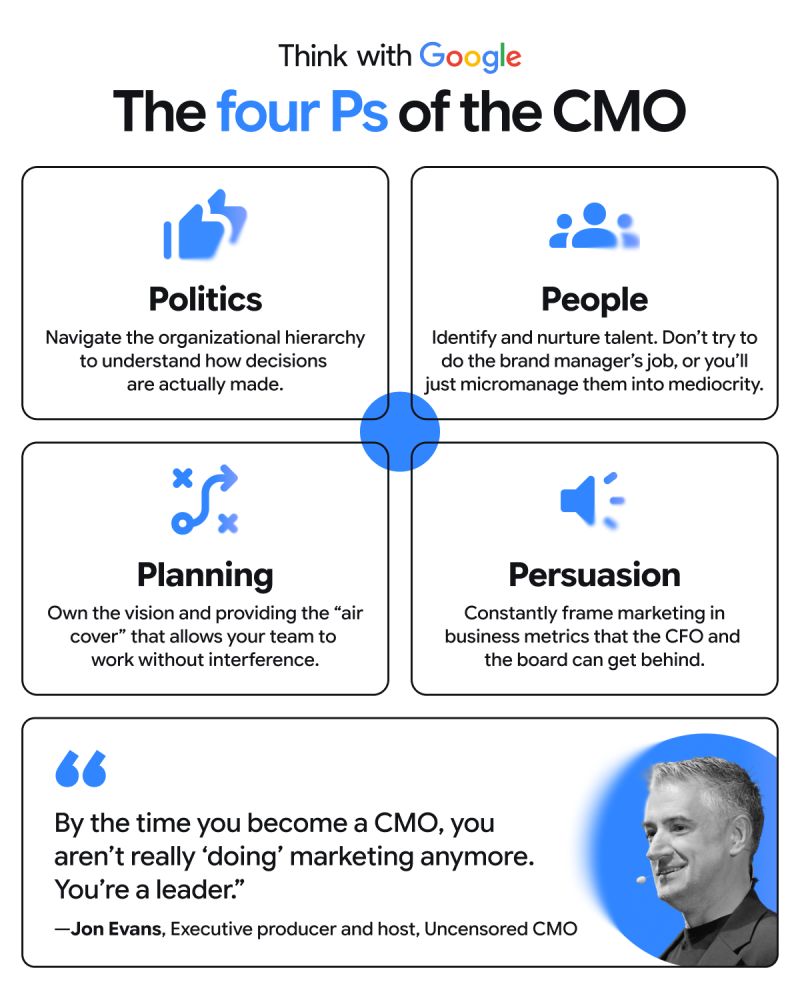
CMOs must be marketers first, not just leaders
I strongly disagree with this.
I even had a “heated” comment exchange with Jon Evans about it.
A CMO is not just another leader.
If CMOs, who literally have “marketing” in their title, stop doing marketing and become “just” leaders, what distinguishes them from any other executive?
How are politics, people, planning and persuasion unique to a CMO?
Aren’t these skills expected from a CFO, CTO, COO, or any leader in general?
Maybe, and I say maybe, only the CEO can afford to be “just” a leader.
Every other C-level executive has a functional responsibility first.
Leadership comes on top.
Leadership is the multiplier.
Functional expertise is the non-negotiable base.
HBR has a piece right on this concept.
Of course, C-level executives don’t do the hands-on work themselves.
But that doesn’t mean they stop doing their function.
A CFO remains an expert in finance.
They still manage the company’s financials and discuss them in depth during investor calls.
The same applies to a CTO.
Nobody has ever argued:
“By the time you become a CFO, you aren’t really doing finance anymore.”
So why should that be true for a CMO?
At the very least, a CMO should define the marketing vision and strategy in detail.
Then delegate implementation to their teams.
A CMO is also the ultimate owner of the brand.
That doesn’t mean micromanaging the brand manager.
It means taking ultimate responsibility, and therefore ownership, of the brand.
If you’re a CEO and apply only these four Ps when hiring your next CMO, you’ll hire a polished corporate politician rather than a marketer.
That is the exact opposite of what marketing needs.
Especially in the Age of AI when change happens at light speed.
I believe this mindset helps explain a brutal gap:
• 43% of CEOs grade their CMOs a “C” or “D” on their ability to drive company growth.
• Only 16% receive an “A”.
• Just 32% of CEOs trust their CMOs, compared with 90% who trust their CFOs.
According to the Journal of the Academy of Marketing Science study, 54% of CMO roles are misaligned.
Meaning, occupied by the wrong people.
That creates a vicious circle.
Almost any corporate worker can learn to become a good corporate politician.
But that doesn’t mean they can drive growth through marketing.
So they don’t make much impact.
But the less impact they make, the more politics they need to justify their position.
The less impact and the more politics they do, the less their CEOs trust them.
A CMO must be a marketer first, and then become more than that.
But they cannot stop being one.