Hey👋,
I'm Giacomo

I will help you make sense of the AI Marketing revolution

Portrait of Giacomo Iotti with short dark hair and brown eyes, wearing a dark turtleneck and a dark checkered blazer against a dark background.

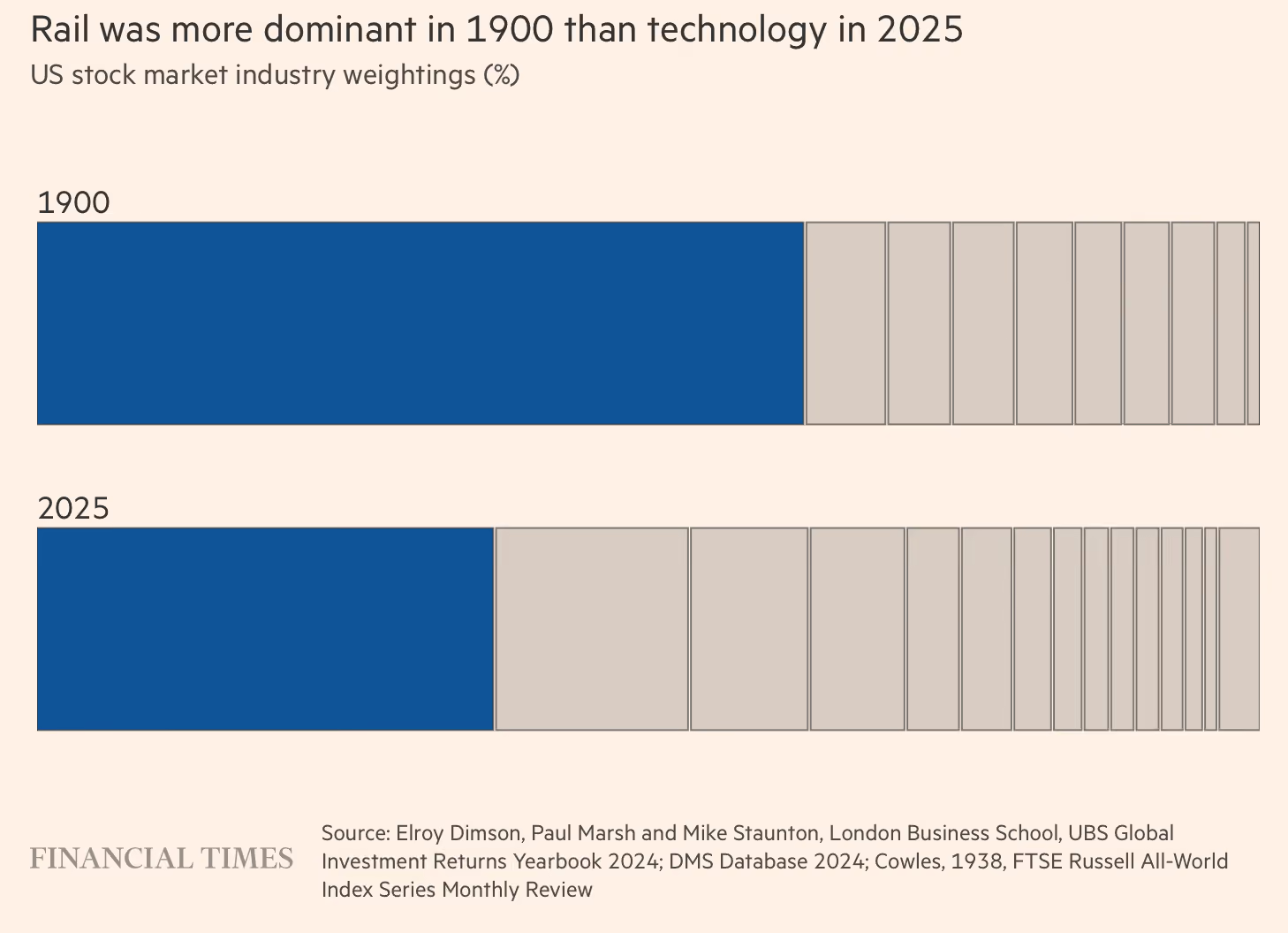
Sunday reads: "Office politics is not optional: learn to play the game or you’ll be its victim" by the Financial Times.

There are two types of office politics, as explained in this video by Harvard Business Review.

👍 Positive office politics

This happens when managers and employees engage in politics to enhance their reputation and build long-term partnerships. This way, they know who to ask when they need something, and vice versa.

In this context, a positive can-do attitude may be more important than actual competence. I would better describe this as "office life" rather than "office politics", as office work inherently requires teamwork and partnerships.

👎 Negative office politics:

This is typically what people think of when they mention office politics.

Negative office politics involve individuals who are solely interested in their personal gain, often disregarding the company, its vision, its people, and even their actual work. This is obviously not exclusive to offices, but it's common also in normal politics and life in general.

Both forms of office politics require hard work and lead to career advancement. However, while the first type can be learnt, the second is exclusive to certain individuals.

I'm definitely not part of the second group, but I do acknowledge that pursuing "negative politics" can lead to rapid career progression.

For people like me, there are two options:

We can either continue to complain and live in frustration, or accept that certain skills cannot be learned, because contradict our personal values and attitudes.

Like many things in life, we must accept reality and set rhetoric aside. Quoting a friend, "sure, it's possible to skip the queue, but are you really that kind of person? just stay in line and wait for your turn."

The image offers an abstract representation of office politics, showing a maze-like office layout with employees navigating through it. This metaphorically represents the complexity and challenges of office politics, with characters forming alliances or being isolated, set in a calculating and competitive environment.
...more
Open on LinkedIn
Expand on page
Portrait of Giacomo Iotti with short dark hair and brown eyes, wearing a dark turtleneck and a dark checkered blazer against a dark background.

AXA Switzerland removes hierarchy. This is a landmark move!

While some level of hierarchy will remain, many intermediate titles such as vice-president will be eliminated, marking the shift from a "status hierarchy" to a "hierarchy of responsibility”. The goal is to enable employees at all levels to make critical decisions about their work, instead of only adhering to top-down directives.

As Daniela Fischer, Head of HR, told NZZ recently, "Bosses don't always know everything best.”

Historically, money and status have been the primary motivators for employees. However, this concept is becoming outdated.

In today's job market, companies not only compete against each other, but they also compete with a wide range of self-employment opportunities. For example, working as a content creator, which is becoming easier to get into and more profitable, also thanks to Ai.

AXA has recognised that especially younger generations are not necessarily motivated by status and money, but rather by long-term purpose and the actual nature of their day-to-day work. If it were solely about money, they could easily work online probably making more than in any regular job. Instead, they’re looking for their skills to be valued and to be respected, no matter of their job title. Being taken seriously is what truly matters for them I believe.

We will see if AXA will be successful in this massive cultural change. Regardless, I hope more companies will test similar structures to adapt to a job market that has undoubtedly changed.

...more
Open on LinkedIn
Expand on page
Portrait of Giacomo Iotti with short dark hair and brown eyes, wearing a dark turtleneck and a dark checkered blazer against a dark background.

Third-party cookies are going away, so what?

There seems to be a lot of confusion about the implications of the third-party cookie's deprecation. It's not an armageddon, nor the end of the internet as we know it. Yet, some things will change, but only for some.

Let me explain:

POV you are an advertiser

If you advertise on platforms such as Google Ads, Meta, TikTok, or Apple Search Ads, there will be little change for you.

Why?

Because those companies are walled gardens.

What does it mean?

They don't need third-party cookies to target users effectively, since they already own sufficient first-party data.

Users generate first-party data whenever they log in. Google knows everything about its logged-in users on Chrome desktop or Android and can track them across any website or app as long as they remain logged in. Sure, not everyone logs into to a Google account, but hey.

The same applies to Apple on iOS (any iPhone user has to be logged-in with an Apple account).

The story is slightly different for Meta and TikTok.

They won't be able to track users outside of their platforms, but there's already huge data to be collected within their apps.

For instance, TikTok determines your preferences by the videos you watch on the platform. Using this information, it can display the right ads to the right users directly within the app. It doesn't require tracking outside of TikTok.

If you were buying ads via other vendors, well, you should probably move to big tech.. what a news! 😄

POV you are other vendors

Yes, third-party cookie deprecation is indeed a problem.

Let’s take Criteo for example.

Criteo is just a technology vendor and does not own any user, browser or device. Their specialty lies in retargeting ads, which do require third-party cookies to identify the same user across different websites. While they might find some technical workarounds, their business model is at risk.

POV you are a publisher

The deprecation of third-party cookies is a problem for small publishers who depend on programmatic ads revenue.

Without third-party cookies, their audience is worthless to advertisers. After all, why should brands purchase ads from small publishers if they don’t know anything about their users?

Different story goes for the large publishers.

Large publishers often own multiple popular websites, providing them with valuable first-party data. This data can be sold directly to advertisers.

Bottom line:

✅ If you're an advertiser, you're okay. Simply reallocate your budget from smaller ad vendors to big tech.

✅ If you're a large publisher, you're mostly okay.

❌ If you're a small publisher, you’re in trouble.

❌ If you're a small/medium ad vendor, you’re also in trouble.

🎉 If you’re big tech, cheers!

Big wins, small loses.

Or am I missing something?

...more
Open on LinkedIn
Expand on page
Portrait of Giacomo Iotti with short dark hair and brown eyes, wearing a dark turtleneck and a dark checkered blazer against a dark background.

Global minimum corporate tax has finally gone live and it's a big deal!

The minimum 15% rate, now active in the EU, Norway, Switzerland, the UK, and other countries, surpasses the previous lower rates in tax havens like Ireland, where it was 12.5% until recently.

I lived in Ireland for several years and the topic of a possible bubble ready to burst at the first tax rate increase, was a frequent subject among expats.

In fact, Dublin is home to many multinational corporations' EMEA HQs, that employ thousands of European expats. Foreign direct investment is worth a staggering 285% of the country's GDP!

I believe this new rate will change nothing. If anything, it will increase tax revenues and further aid the country's development.

The appeal of Ireland for multinational companies extends way beyond its low corporate taxes:

  1. Only English-speaking country in the EU post-Brexit.
  2. Proximity to the US, with Dublin being the EU's closest capital by flight time.
  3. An exceptionally welcoming culture.
  4. This makes Ireland a welcoming home for many European expats/immigrants.
  5. Therefore, a wealth of multilingual, skilled talent.
  6. A stable political environment.
  7. A stable climate (yes it rains all the time, but at least you know and it never changes 😁).
  8. Even at 15%, it remains the lowest possible rate, lol :)

Bonus point: With global warming, Ireland will become an amazingly beautiful seaside destination! 😅

...more
Open on LinkedIn
Expand on page
Portrait of Giacomo Iotti with short dark hair and brown eyes, wearing a dark turtleneck and a dark checkered blazer against a dark background.

I created my first public GPT! Find it here.

It's called "Improve Text" and well, what it does is improving text 😁

I specifically designed it for professional online content like #blog articles or #Linkedin posts.

It uses advanced vocabulary, but it ensures the text is always to the point and easy to read for everyone.

Simply copy and paste a paragraph with no additional prompting to get started!

Oh, and let me know how you like it!

...more
Open on LinkedIn
Expand on page
Portrait of Giacomo Iotti with short dark hair and brown eyes, wearing a dark turtleneck and a dark checkered blazer against a dark background.

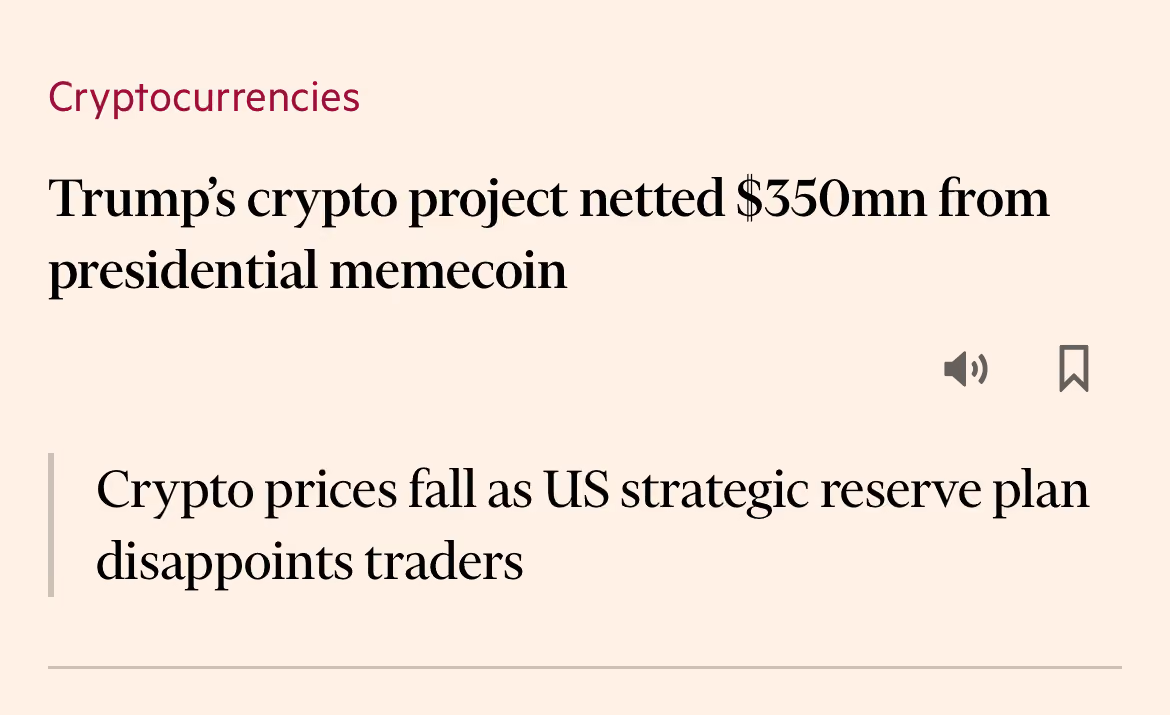
Breaking News: The SEC has finally approved Bitcoin spot ETFs in the US, but is it really a cause for celebration?

The Irony

The essence of Bitcoin was to sidestep traditional banking and financial systems. Yet now, it's embraced and sold by the world's largest financial institutions.

The Reality

The move doesn't symbolise an institutional endorsement of Bitcoin's philosophy. Instead, it represents a simple business and marketing strategy aimed at capitalising on the ongoing craze.

The Financials

According to the Financial Times, big players like BlackRock and Greyscale will charge 0.5% and 1.5% fees respectively. Their goal is to generate real US dollar revenue 💵 and upsell other high-margin products to new young clients.

The Impact

For Bitcoin believers, this is bad news. The philosophy of Bitcoin as an alternative to traditional finance has essentially failed.

For speculators and Wall Street, this is a win. Bitcoin price will likely go up, while institutions will cash-in large fees in the meantime.

The risks

Dennis Kelleher, speaking to the Financial Times, said the approval “is a historic mistake that will not only unleash crypto predators on tens of millions of investors and retirees but will also likely undermine financial stability”.

So what's left of Bitcoin other than speculation?

💡 Any thoughts?

...more
Open on LinkedIn
Expand on page
Portrait of Giacomo Iotti with short dark hair and brown eyes, wearing a dark turtleneck and a dark checkered blazer against a dark background.

We live in a world where social media users and fans believe they know more than industry experts and lawyers, often ignoring facts and legal principles.

Here's the situation

Taylor Swift's decision to re-record her first six albums to reclaim the rights to her music has inspired her global fanbase. They are now urging other artists to follow suit.

The facts

When discussing "music ownership," we're referring to the rights to the "masters" - the original recordings of songs. In the past, masters were tangible, typically stored as tapes in record label warehouses, making physical ownership clear. Today, these masters exist as digital files, but the concept of ownership remains unchanged.

Recording an album to a professional standard is costly, often amounting to tens of thousands of dollars. Collaborating with top-tier engineers and musicians, and using high-quality equipment doesn't come cheap.

This raises a critical question:

Who pays?

Whoever pays the bill gets ownership of the "masters". This is because the financier aims to recoup their investment - the music industry is not a charity.

Traditionally, record labels have born the cost of album production and promotion, acting like today's VCs in the tech industry.

Taylor Swift's case is unique, as her masters were re-sold to a third party she disapproved of, who refused to sell them back. Her frustration is understandable.

But it doesn't have to be this way: Paul McGuinness, the legendary manager of U2, used to negotiate reduced investment from record labels to retain masters' ownership.

The value of a recording is easy to determine in retrospect. But when a record label invests in a debut album, the financial risk is extremely high, and it's only logical for the label to expect something substantial in return.

...more
Open on LinkedIn
Expand on page
Portrait of Giacomo Iotti with short dark hair and brown eyes, wearing a dark turtleneck and a dark checkered blazer against a dark background.

It was a pleasure presenting our latest Ai marketing projects to SMG Swiss Marketplace Group last week.

Ai is disrupting almost every industry, but I am a firm believer that marketing is one of the most impacted.

From operational work to data analysis, ChatGPT and Ai in general enhance our work unlocking creativity and making us save hundreds of thousands of euro/francs and countless hours.

But again... this is just the beginning!

...more
Open on LinkedIn
Expand on page
Portrait of Giacomo Iotti with short dark hair and brown eyes, wearing a dark turtleneck and a dark checkered blazer against a dark background.

Technology has become a commodity.

I've always been under the impression that great brands don't need advertising, as their products or technology alone secure a competitive advantage.

Is it still the case?

Jeff Bezos mentioned in 2009 that advertising was just for “unremarkable” products. 10 years later, Amazon is by far the largest advertiser in the world.

Do they offer an “unremarkable” product, then? May be.

Or more likely, Jeff Bezos was wrong.

I was reading the latest presentation by Benedict Evans when a slide about ad spend by Expedia Group and Booking.com caught my attention.

Despite already being leaders in the travel industry, they spend almost 50% of their revenue on advertising and marketing. How come?

Well, the reality is that their strongest asset is their brand, not their technology!

At the end of the day, they just bundle together someone else's products, (same as Amazon, by the way). Anybody could replicate their platform, in theory.

But what nobody could replicate is their name in the market, both in the consumer and in the B2B space.

How to build a name in the market? marketing & advertising, of course!

With the advent of AI, technology has truly become a commodity. Even very complex tasks are now easily solvable for a relatively low cost. With some exceptions, of course.

Also, technology is evolving at an extremely fast pace. The likelihood that your product will become obsolete next year is high.

So…

➡ ➡ You can no longer rely solely on your product or technology as your value proposition.

Now more than ever, you need to keep fostering your brand!

...more
Open on LinkedIn
Expand on page
Portrait of Giacomo Iotti with short dark hair and brown eyes, wearing a dark turtleneck and a dark checkered blazer against a dark background.

Will TikTok be banned in the US?

Hint: probably not...

However, something is definitely happening, as Shou Zi Chew, CEO of TikTok, was asked to testify before the US Congress last week.

Who is Shou Zi Chew and why haven't we heard of him before? 🤔

He's a very different type from his Silicon Valley peers. His personality is one of the factors that will prevent the US Congress from banning the short-video app.

Class 1983, he was born and raised in Singapore, of Chinese ancestry like many of his compatriots.

He's always been a high achiever.

At age 12, he managed to get into an elite high-school thanks to his high marks. Not long after, he was put on the officer track of the Singaporean military. He then succeeded in an extreme survival course in Brunei’s jungles, when he had to kill and eat a live quail (not clear whether he actually ate her).

While still being a reservist in the army, he moved to London to study business and went on to work as a banker for Goldman Sachs. After that, he even interned at Facebook, when the company was little more than a promising scale-up.

But the real deal was joining the venture-capital firm DST Global, in the US. He quickly became the go-to person for key investments in China, also thanks to his Mandarin skills.

After investing in Xiaomi Technology, a Chinese smartphone giant, he was asked to join in as CFO and later as director of international business. He stood out for his deep understanding of both Chinese and Western business cultures.

At the time of DST Global, he had the chance to be among the first investors of ByteDance, which later went on to create TikTok.

It is its founder, Zhang Yiming, who personally called Chew to join TikTok as its new CEO in 2021, based in Singapore.

Literally a "hero of two worlds", he's now the connection between the western and Chinese tech industries.

He speaks Mandarin, but he's native in English. He's worked in China, but has a Taiwanese-American wife, met in America. He studied in Britain and worked for Goldman Sachs, the temple of American capitalism.

He now claims that data of American citizens is carefully kept on American and Singaporean soil, shielded from Chinese authorities.

Why would the congress not believe a Goldman alumni?

More importantly, who is brave enough to stop 150mln American citizens from using their favourite app?

...more
Open on LinkedIn
Expand on page